

Gerry & Sewell
A love letter to Geordie spirit, fuelled by football, friendship and the Toon.
Based on Jonathan Tulloch’s novel The Season Ticket, which later became the cult film Purely Belter, Jamie Eastlake’s new stage adaptation Gerry & Sewell storms into the West End following sell-out performances across the North East. There is no denying the affection behind this production: it is clearly made with heart, pride and a deep-rooted love for its Geordie identity.
The show stars original cast members Dean Logan, Jack Robertson and Becky Clayburn as Gerry, Sewell and Brabin respectively. Of the cast, Jack Robertson emerges as both performer and, crucially, the driving force behind the production. His portrayal of Sewell is delivered with an almost aggressively deadpan nonchalance that becomes increasingly funny, particularly when he breaks the fourth wall to comment on the contemporary dance sequences and stylised flashbacks.

These moments of self-awareness are genuinely effective; Robertson’s commentary gives the audience permission to laugh at what might otherwise feel indulgent. Without him poking fun at these sections, we would be left with choreography that is occasionally underwhelming and, at times, a little cringeworthy. His comic timing carries the show through several transitions that might otherwise have stalled its momentum.
Robertson also takes on the role of Sewell playing Gemma – a simple, playful piece of comedy that clearly delighted the audience. While enjoyable, it does feel somewhat detached from the main narrative drive. That slight sense of narrative drift recurs elsewhere, though the show is at its strongest when it leans fully into its theatrical confidence. One of the undoubted highlights is a reworking of Barry Manilow’s I Write the Songs, with lyrics adapted to fit the themes of the piece. It lands beautifully and is one of the few moments where everything; music, tone and storytelling aligns perfectly.
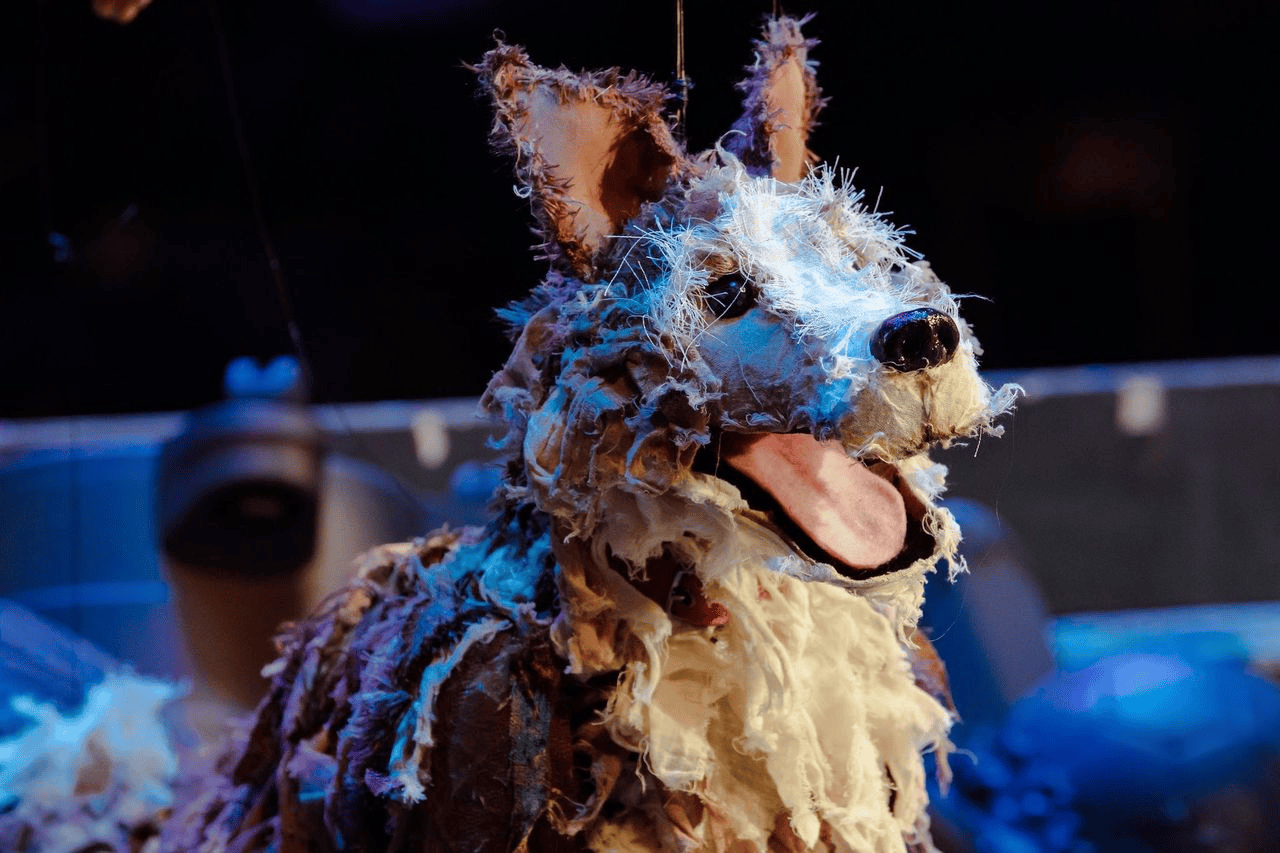
Another standout element is the puppetry. Predominantly interacting with Robertson, the puppets are handled with real skill by the team, and their presence adds warmth and charm. The scene between Sewell and the cat is particularly funny, while the relationship between Sewell and the dog, who seem to exist on the same wavelength, is quietly delightful. Credit here must go to the puppet designers and operators, whose work is detailed, expressive and well integrated.
Despite these strong moments, the show is less a comedy and more a play with jokes added in. Tonally, it struggles to settle. I found it difficult to place exactly when the action is set, as there are numerous time markers that actively contradict one another: Edd the Duck, vaping, Facebook, a Nokia ringtone, modern smartphones and even references to COVID all exist side by side. This temporal confusion never feels intentional enough to be a stylistic choice, and instead becomes distracting.
Becky Clayburn’s Brabin is another element that feels underdeveloped. There are moments of spoken-word, poetry-slam-style narration used for scene setting, which I found hard to follow. We then move swiftly into revelations about her sexuality and the loss of her dog. Conceptually, this could have worked, but in practice it needed clearer signposting; a costume change or a more dramatic theatrical shift. In 2026, audiences no longer erupt into applause at the mention of a character’s sexuality, and the rehearsed pause for a cheer made that moment feel awkward rather than affirming.
The show is also unapologetically niche. While many plays revolve around football, this one is specifically rooted in Newcastle United Football Club culture. There are jokes about managers, players and local lore that clearly delighted some audience members but left others slightly behind. A heavily hyped musical number, presented as a local lad destined for greatness, never quite landed for me; I expected recognition or parody, but instead it felt oddly earnest and obscure.
Ultimately, Gerry & Sewell feels like a piece written with youth theatre very much in mind. Many companies would relish performing it. It touches on a wide range of serious issues; domestic abuse, rape, running away from home, drugs, crime and even murder but never fully commits to exploring any of them in depth. They appear, make their point, and then move on. Strikingly, if you examine the narrative closely, Mr McCarten (Bill Fellows), the villain of the piece, is arguably the only character who truly comes out on top.
There is a lot to admire here: passion, community spirit and flashes of genuine theatrical joy. What the show perhaps needs is a clearer sense of focus, both narratively and tonally, to match the ambition and affection that so clearly underpin it.

Photo Credit: Von Fox Promotions
You must be logged in to post a comment.